
An Ancient Greek Pizza known as Ladenia Kimolou that’s so delicious, we’re still making it!
Watch the Video

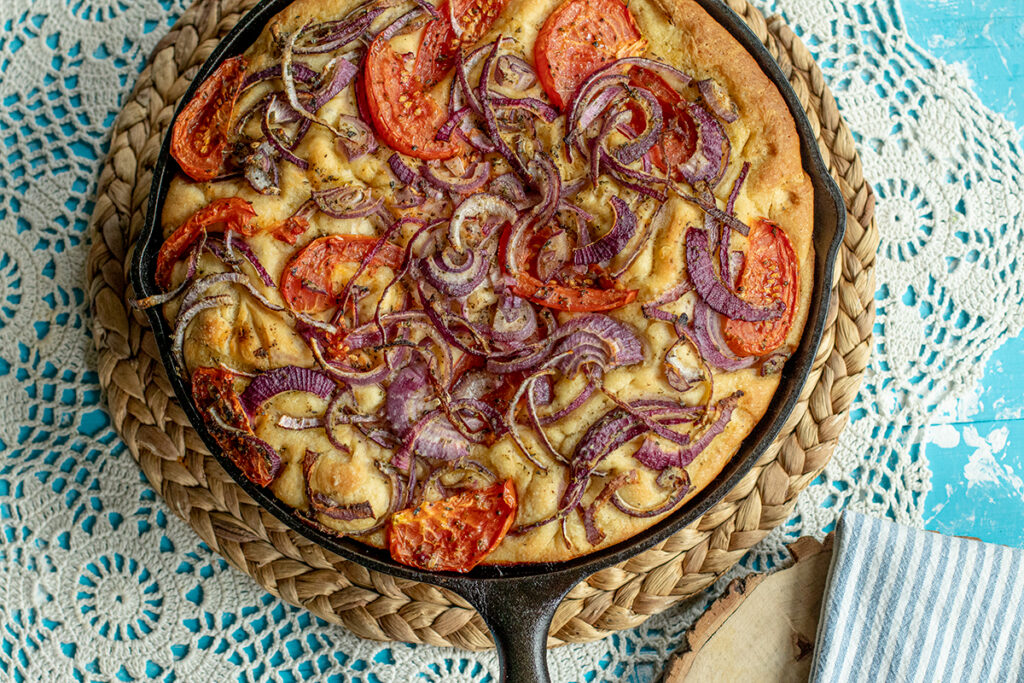
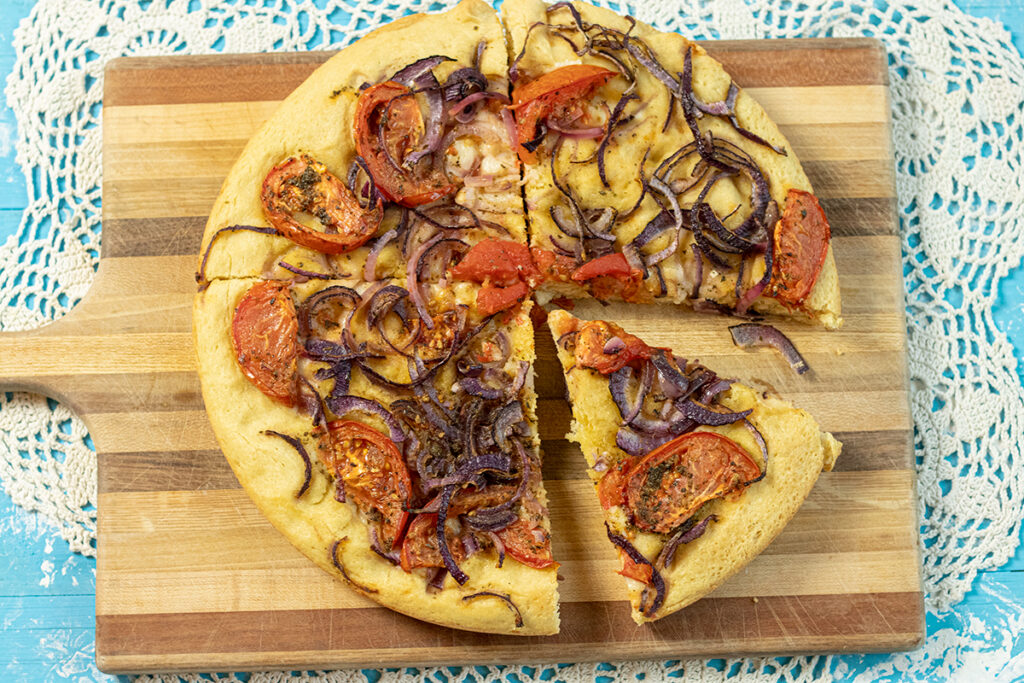
The ancient Greek pizza known as Ladenia Kimolou is the original pizza made by the beautiful people of Kimolos island in Greece. It has a flatbread base with vegan toppings. No dairy, cheese, or feta. It’s so flavorful, delicious, and can be served in so many different ways. It’s easy to make, and I can’t wait for you to try it!
What Is Ladenia Kimolou?
Ladenia is a traditional specialty of Kimolos, a small Greek island in the Cyclades. It’s a rustic, focaccia-like flatbread topped with fresh tomatoes, onions, oregano, and olive oil.
You’ll sometimes hear ladenia described as an ancient Greek pizza or one of Greece’s earliest versions of pizza. I prefer to simply call it a traditional Greek pizza or flatbread from Kimolos. The tomato-topped version we know today couldn’t literally be ancient since tomatoes arrived in Europe much later.
Whatever you call it, this is Greek simplicity at its best: good bread, ripe vegetables, oregano, and lots of extra virgin olive oil!
You’ll want to make this every week!
- Crispy crust
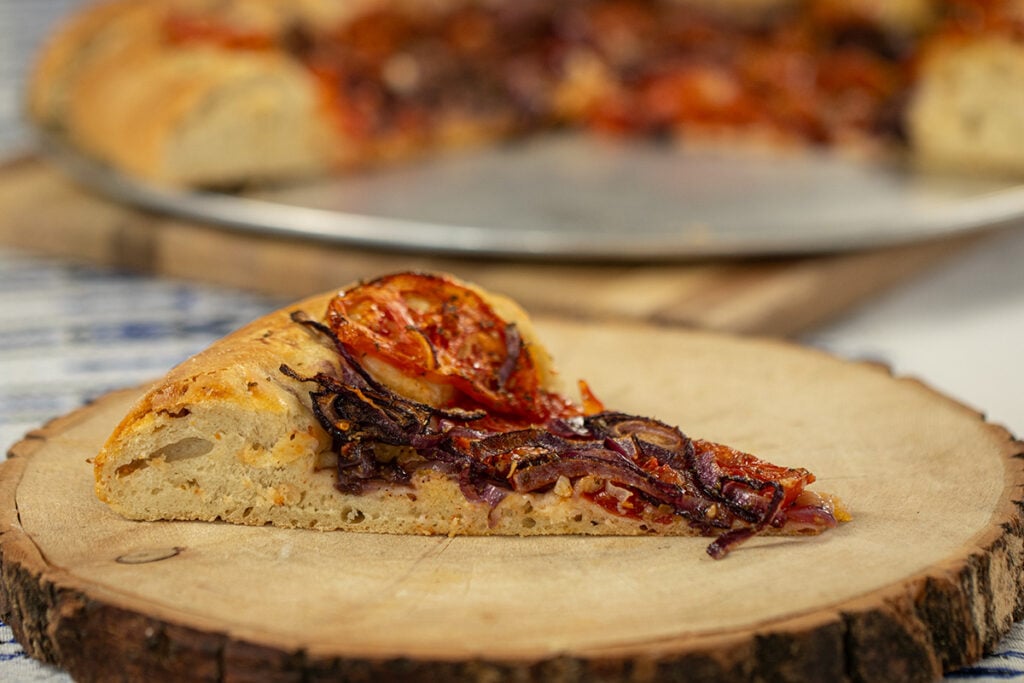
- Soft bread center
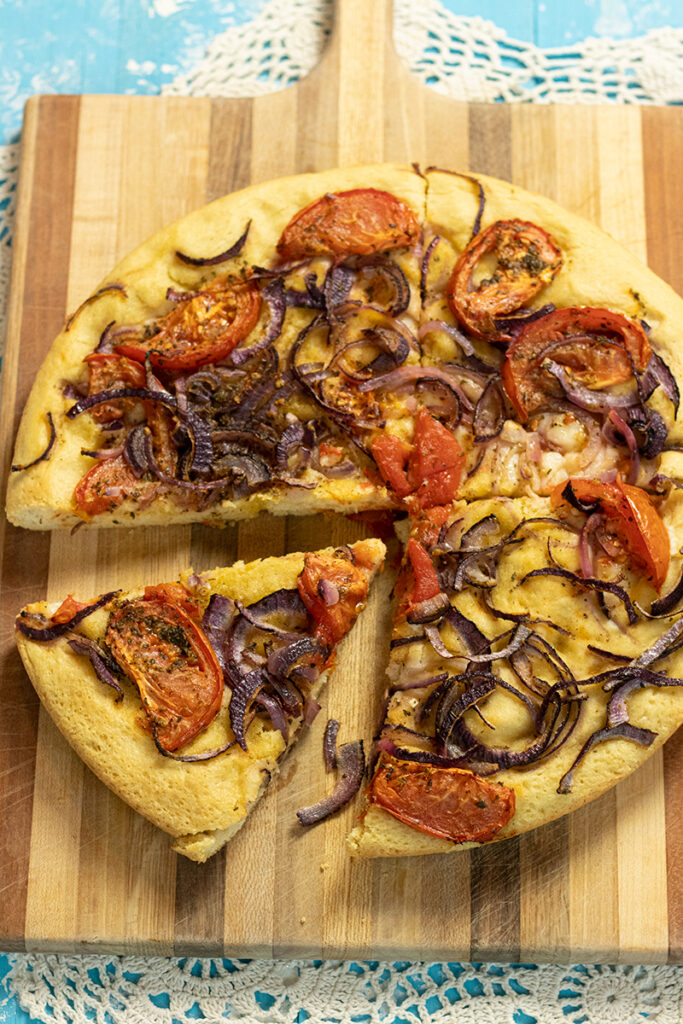
- Caramelized onions with sweet roasted tomatoes
- Can be the entrée or a side!!
What is the best pan to use for Ladenia Kimolou?
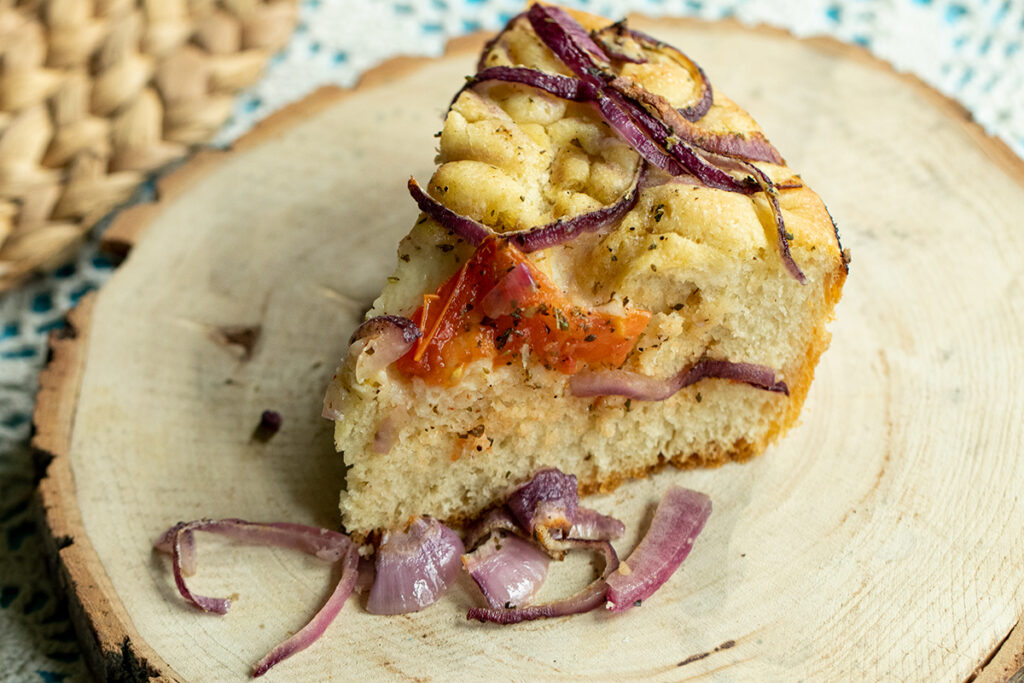
The pan you choose will change the texture and thickness of your ladenia.
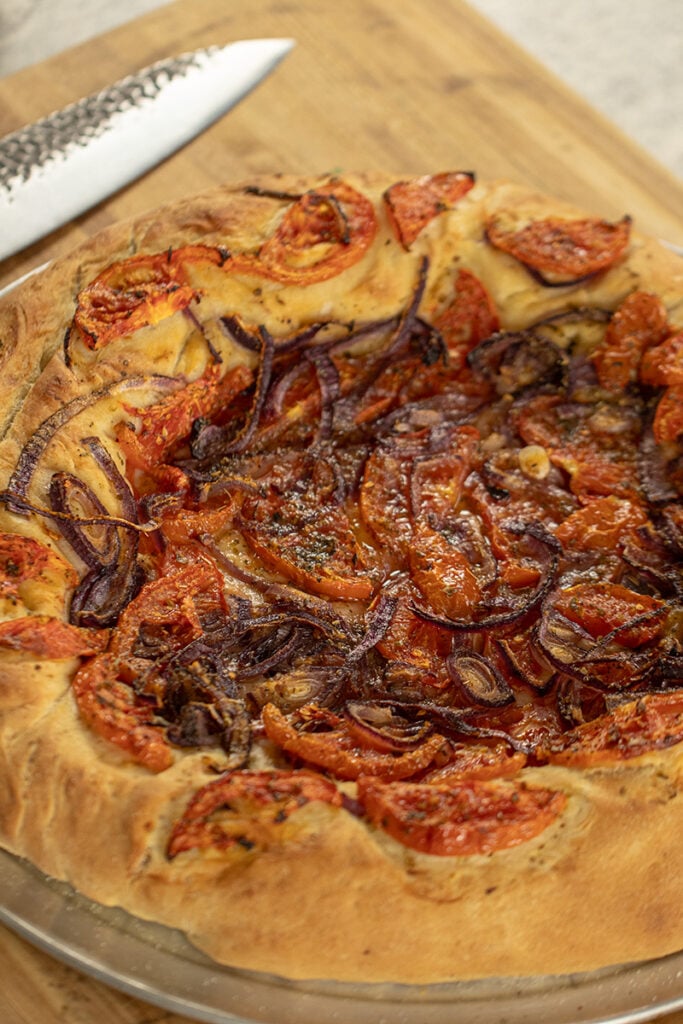
My favorite is a 16-inch round metal pizza pan. It gives the ladenia a beautiful round shape and a wonderful balance between a fluffy center and crispy edges.
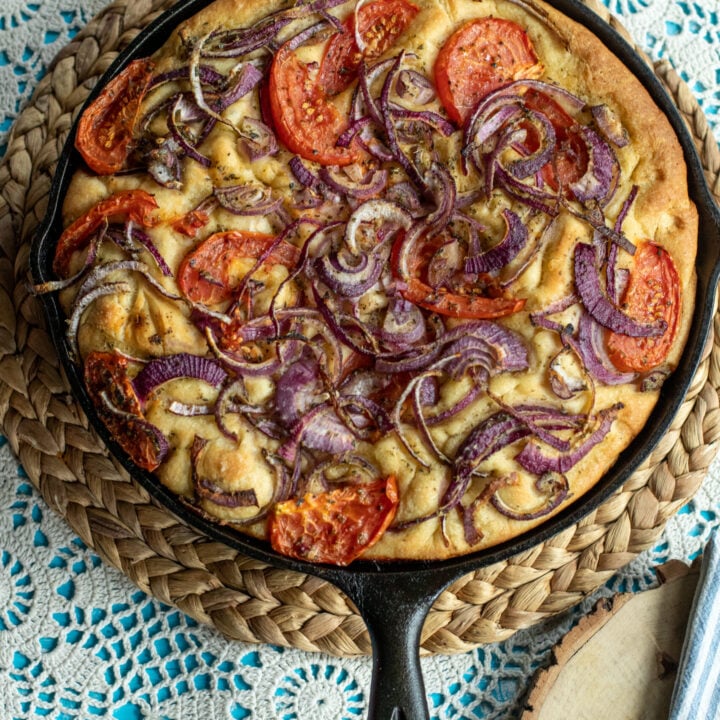
For a thicker, softer ladenia, you can use a large cast-iron skillet. Keep in mind that the smaller surface area means the dough will be considerably thicker.
If you prefer a thinner, crispier Greek pizza, spread the dough onto a half-sheet baking pan.
The exact baking time can vary slightly depending on the size and material of your pan, so use the color and texture of the crust as your guide.
This is why Ladenia Kimolou is so good
- Lukewarm water
- Granulated sugar
- Active dry yeast
- All-purpose flour
- Bread flour
- Salt – Salt is a big yeast killer. Never put salt directly into your yeast water.
- Olive oil –use a good quality since it flavors your bread
The toppings:
- Tomatoes sliced into wedges
- Red onion
- Olive oil
- Salt and black pepper to taste
- Dried crushed oregano
How to prepare the yeast
You’ll start by dissolving the yeast in 2 cups of lukewarm water with sugar and a little all-purpose flour. The sugar and flour will feed the yeast to help it get started. Rarely will your yeast be bad. However, if you don’t take this step to make sure your yeast is active, you may have to throw everything out, wasting all of your ingredients. So, you don’t want to skip this step.
Set it aside for about 8-10 minutes until the mixture gets foamy. If it doesn’t foam or have a cloud on top, start again with new yeast. If it does foam, that’s how you know your yeast is good, your bread will rise, and it will be nice and fluffy.
How to make the Ancient Greek Pizza Ladenia Kimolou
- In the bowl of a tabletop mixer that has been fitted with the dough hook attachment, add the water, yeast, sugar, and 1/4 cup of flour.
- Mix it together and let it sit for 8-10 minutes to proof. The yeast is ready when it forms a cloud at the top of the mixture.
- In a large mixing bowl, mix the bread flour and salt.
- Once the yeast is ready, add the flour mixture to the mixing bowl and the quarter cup of olive oil. Knead on low speed for 10 minutes.
- Transfer the dough into an oiled bowl and cover with plastic wrap. Set it aside in the warmest part of your home to rise until doubled in volume. About 1-2 hours.
- Preheat the oven to 400 °F, 200 °C.
- Grease a 12-inch (30 cm) round pan or a 9 x 13-inch baking tray with olive oil.
- Spread the dough onto the prepared pan and set it aside while you prepare the topping.
- Add the tomato and onion to a bowl. Drizzle with olive oil and season with salt, pepper, and oregano. Toss together and place the veggies on top of the dough.
- Bake on the center rack for 35-40 minutes.
- Allow the bread to cool for 5-10 minutes before serving
Does Traditional Ladenia Have Cheese?
No! Traditional Ladenia Kimolou is made without cheese.
That’s part of what makes this recipe so delicious. Instead of relying on cheese or sauce, the flavor comes from ripe tomatoes, sweet onions, oregano, olive oil, and freshly baked bread.
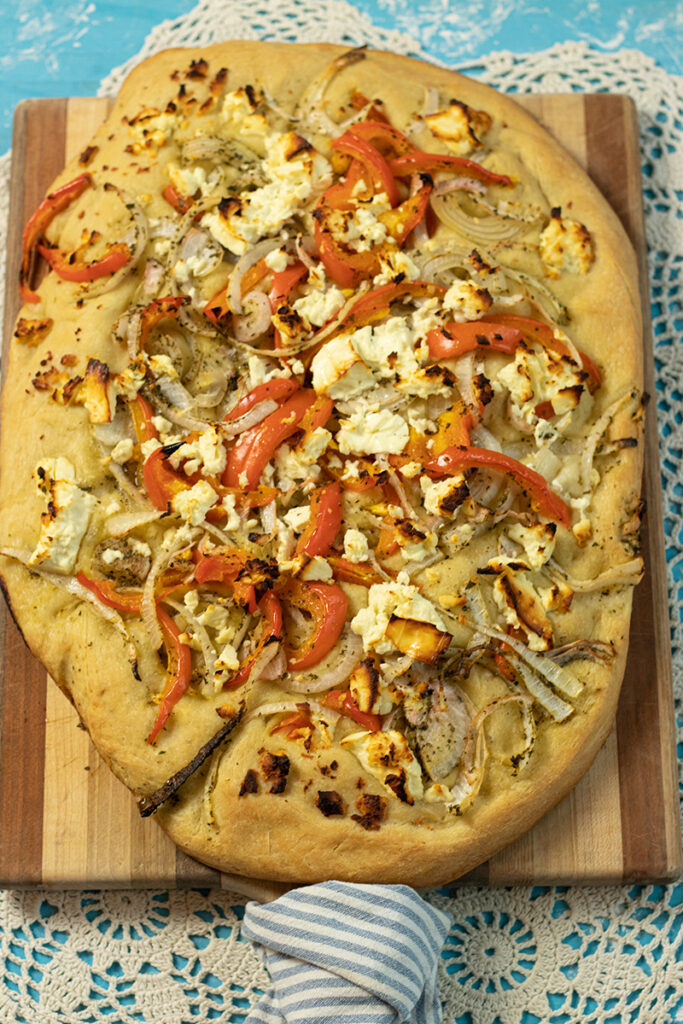
That said, I’m never going to stop you from adding cheese!
Feta is delicious on ladenia, and you can also add mozzarella or another cheese that you love. Just keep in mind that once you start adding different toppings, you’re moving away from the traditional Kimolos version—which is perfectly fine in my kitchen!
Topping Ideas
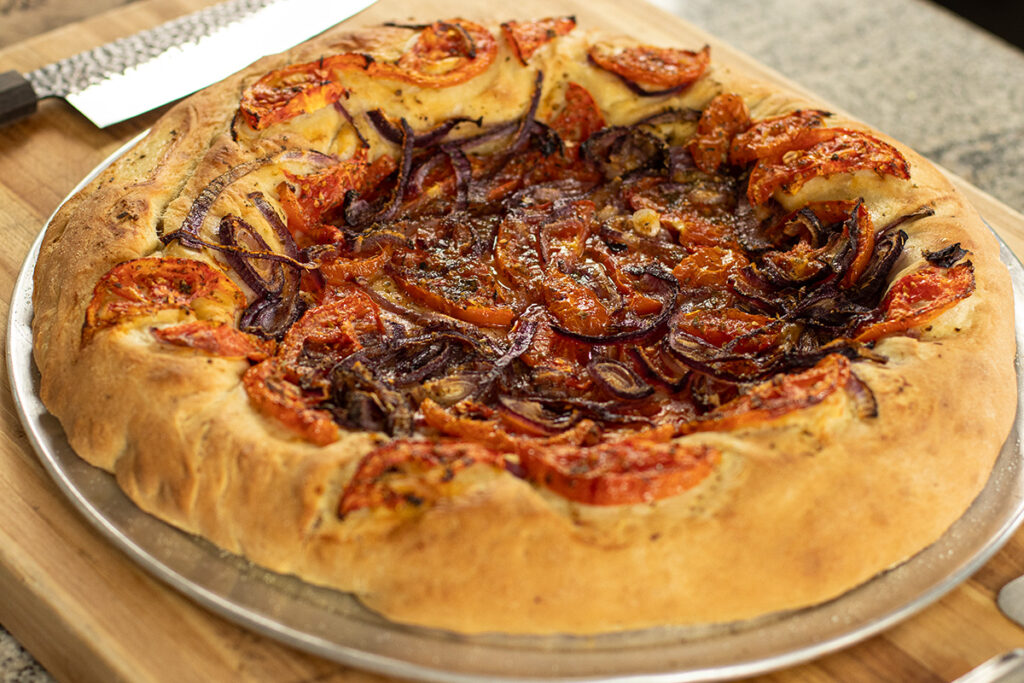
Once you’ve made the traditional version, have fun with it.
Try adding:
- Crumbled feta
- Mozzarella
- Kalamata olives
- Roasted red peppers
- Fresh peppers
- Capers
- Fresh herbs
- Chili flakes
- Any of your favorite pizza toppings
You can even divide the dough and make different sections with different toppings if everyone wants something different.
Tips for the Best Ladenia
Slice the tomatoes thinly. Thick tomatoes can release a lot of liquid and make the top of the dough too wet.
Use plenty of olive oil. This isn’t the recipe to skimp on it. Olive oil gives ladenia its characteristic flavor and helps create that gorgeous golden crust.
Don’t forget the semolina. A little semolina on the bottom of the oiled pan adds texture and helps prevent sticking.
Let the dough rise fully. Depending on the temperature of your kitchen, this may take anywhere from 1-2 hours.
Give the dough a rest if it fights you. If it keeps shrinking back while you’re stretching it into the pan, leave it alone for 5-10 minutes. The gluten will relax and it will become much easier to stretch.
Move it to the top rack at the end. I bake mine for 25 minutes on the middle rack and then another 10 minutes on the top rack. That final blast of heat helps beautifully roast the vegetables and brown the top.
Choose your pan based on the crust you like. Use a cast-iron skillet for thicker ladenia, a large metal pizza pan for something in between, or a half-sheet pan for a thinner crust.
Serving
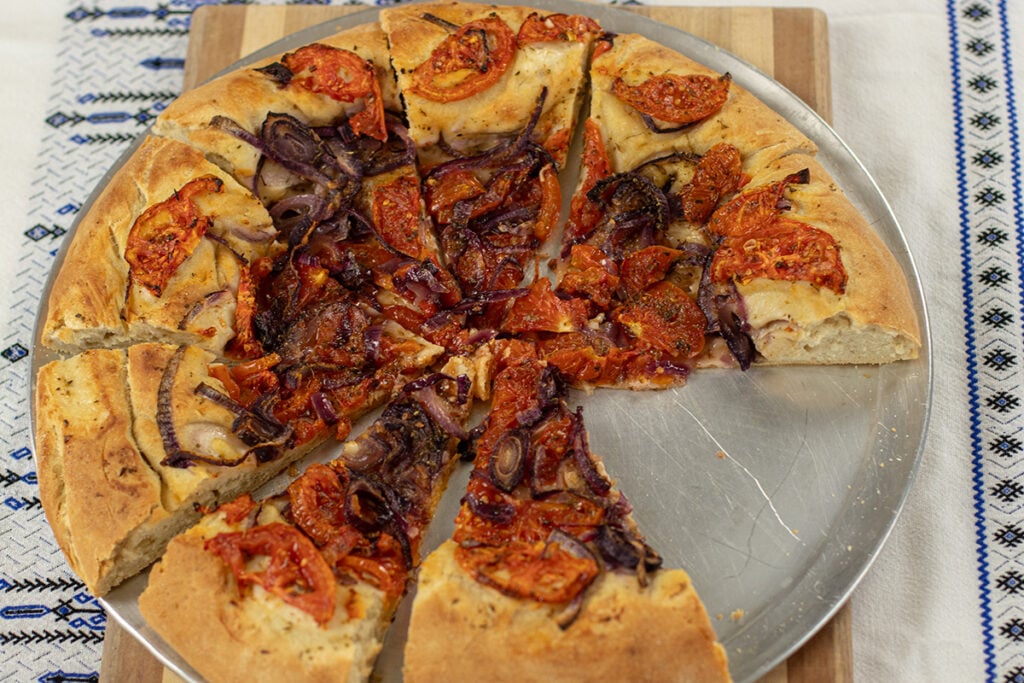
There are so many different ways to serve this ancient Greek pizza! First, it can be served hot or at room temperature. It’s delicious either way. I like to cut it on a cutting board into wedges, especially when using a round pan. It looks so pretty. Cut it however you like, though.
Second, you don’t have to serve this as a delicious pizza meal with a side salad. I want to eat this in the morning with some eggs, or you could even use it as dipping bread for a stew! It’s so versatile. Let me know how you serve it!
More Bread Recipes:
- Greek Feta Bread: Tiropsomo: Soft & Delicious!
- Homemade Greek Olive Bread
- Koulouria Thessaloniki’s: Greek Bread Rings
- The Softest Pita Pocket Recipe: The Oven Method

Ladenia Kimolou: Traditional Greek Pizza from Kimolos
Ladenia Kimolou is a traditional Greek flatbread pizza from the island of Kimolos. A soft, olive oil-rich dough is topped simply with thinly sliced tomatoes, red onion, oregano, and plenty of extra virgin olive oil, then baked until golden and crisp around the edges. Traditional ladenia is naturally vegan and made without cheese, but you can easily customize it with feta, other cheeses, olives, peppers, or your favorite pizza toppings.
Ingredients
For the Dough
- 2 cups lukewarm water
- 1 teaspoon granulated sugar
- 1 1/2 teaspoons active dry yeast
- 1/4 cup all-purpose flour
- 4 cups (615 g) bread flour
- 1 1/2 teaspoons salt
- 1/4 cup extra virgin olive oil
For the Pan
- Extra virgin olive oil, for greasing
- Semolina flour, for dusting the pan
For the Topping
- 2 tomatoes, thinly sliced
- 1 red onion, thinly sliced
- 1/4 cup extra virgin olive oil
- 1 tablespoon dried crushed oregano
- Salt, to taste
- Freshly ground black pepper, to taste
Instructions
In the bowl of a tabletop mixer fitted with the dough hook, combine the lukewarm water, sugar, yeast, and 1/4 cup all-purpose flour. Whisk together and set aside for 8–10 minutes, until the mixture becomes foamy. This lets you know that the yeast is active.
In a separate bowl, combine the bread flour and salt. Once the yeast mixture is foamy, add the flour mixture and 1/4 cup olive oil to the mixer. Knead on low speed for about 10 minutes, until a soft, smooth dough forms.
Transfer the dough to a lightly oiled bowl, cover, and place in a warm area for 1–2 hours, or until doubled in volume.
Preheat the oven to 400°F (200°C).
Generously grease a 16-inch round metal pizza pan with olive oil and lightly sprinkle it with semolina. Transfer the dough to the pan and gently press and stretch it toward the edges. If the dough springs back, let it rest for 5–10 minutes, then continue stretching.
Arrange the thinly sliced tomatoes and onions evenly over the dough. Drizzle the vegetables with 1/4 cup olive oil and season with oregano, salt, and freshly ground black pepper.
Bake on the middle rack for 25 minutes. Transfer the ladenia to the top rack and continue baking for about 10 minutes, or until the edges and top are beautifully golden and the vegetables are roasted.
Allow the ladenia to cool for 5–10 minutes before slicing. Serve warm or at room temperature. Kali Orexi!
Notes
Choose your pan depending on the crust you want. A 16-inch round metal pizza pan makes a classic medium-thickness ladenia with plenty of crisp edges. For a thicker, softer flatbread, bake it in a large cast-iron skillet. For a thinner and crispier ladenia, spread the dough over a half-sheet baking pan.
Use semolina on the pan. A light sprinkling of semolina underneath the dough helps prevent sticking while adding a little extra texture and crunch to the bottom crust.
Slice the tomatoes thinly. Thin slices roast more evenly and release less moisture onto the dough than thick wedges.
Don't skimp on the olive oil. Olive oil is one of the defining flavors of ladenia, so use a good-quality extra virgin olive oil.
Traditional ladenia does not contain cheese. The classic Kimolos version is topped simply with tomatoes, onions, oregano, olive oil, salt, and pepper. However, feel free to make it your own. Feta, mozzarella, olives, roasted peppers, capers, or other favorite pizza toppings are all delicious additions.
Watch the final 10 minutes. Moving the ladenia to the upper rack helps the tomatoes and onions roast and gives the top beautiful color. Since ovens vary, check it toward the end so that the onions don't become too dark.
Serve it warm or at room temperature. Ladenia is excellent as a meal with a salad, as part of a mezze spread, or sliced into smaller pieces for entertaining.
Recommended Products
As an Amazon Associate and member of other affiliate programs, I earn from qualifying purchases.
-
 American METALCRAFT, Inc. Pizza Pan,Wide Rim,16 In.
 -
TEAKHAUS Wood Cutting Board Block I Chopping Board I Wooden Cutting Boards for Kitchen I Large Cutting Board with Handle I Chopping Boards for Kitchen I Thick Cutting Board 107 24x18x1.5
-
Staub Ceramics Rectangular Baking Dish Set, 2-Piece, Rustic Turquoise



Anxious to learn from you
Bravo. This works well and I have made a similar one many times and infact had one for breakfast today but added different peppers, hot chilli and olives.
BUT for the Italian folk out there, no offence but your ancestors did NOT invent Pizza. I learned this fact from 2 great Australian TV chefs decades ago
Thanks for the recipie. It’s not really ancient, there were no tomatoes in Greece before Columbus. Made it this evening, because we had no tomato sauce, but fresh tomatoes. The dough is sticky and tastes differently from regular pizza. The onions caramelized niceley. We added small chunks of goat cheese and black dried olives.